The First Three Seconds Decide Everything
Walk into any footwear outlet. The customer’s eyes scan the space in under three seconds. A shoe custom retail standing rack for footwear brand retail outlet does not just hold product. It fights for attention against hundreds of competing visual signals.
Consequently, the rack must do one job immediately: stop the scroll in real life. Traditional wall shelving often fails here. It blends into the background. A standalone custom rack, conversely, creates a visual anchor that pulls foot traffic deeper into the store.
Materials That Match Brand DNA
Material selection signals brand positioning before a customer reads a single price tag. Moreover, factories now offer more options than most retailers realize.
MDF with baking paint delivers sharp colors and smooth finishes for mid-tier brands. Acrylic adds transparency and lightness, which works well for women’s fashion footwear. Cold-rolled steel provides structural strength for high-traffic outlets, supporting heavy display loads without bending.
For premium positioning, veneer and stone bases communicate craftsmanship. One Guangdong factory with over 15,000 square meters of workshop space runs dedicated wood, paint, and metal production lines under one roof. That means a single vendor can deliver a mixed-material rack without coordinating multiple suppliers.
The Rocking Mechanism Nobody Talks About
A shoe display rack invention from the 1930s solved a problem that still matters today. The frame used curved rockers so the salesman could tilt the rack for customer inspection. Now, most modern standing racks skip this feature entirely. That is a mistake.
When a customer picks up a shoe, the engagement deepens. Consequently, conversion odds rise. A fixed vertical display, however, forces customers to bend or crouch. That friction kills impulse decisions. Custom racks with adjustable angles or removable bars reduce that friction dramatically.
Real Project: APL Soho Flagship
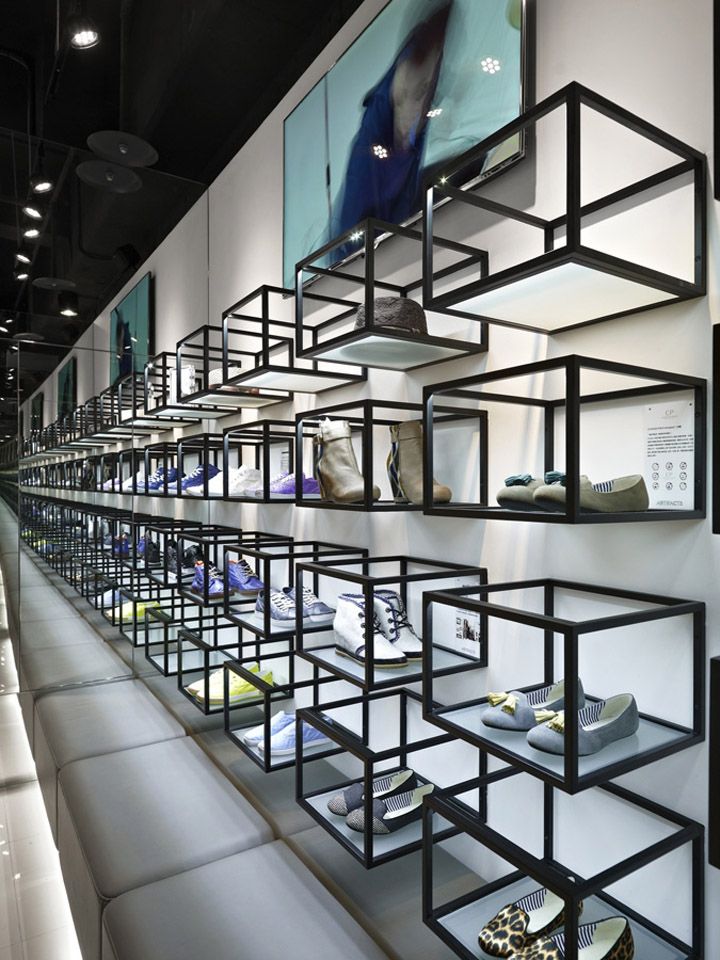
Athletic Propulsion Labs opened a Soho boutique with over 200 custom display cases. Each case was fabricated from 6mm aluminum sheets, bent at three precise points. The cases were electrified and installed just one centimeter apart.
The result? APL’s founders reported an “unbelievable” conversion rate. Notably, the display system became the store’s primary lighting source. Shoes floated in illuminated boxes. Customers came for the experience, not just the product.
This matters for B2B buyers. A standing rack is not furniture. It is conversion infrastructure.
Modularity Extends the Investment
Footwear brands rarely keep the same merchandising plan for twelve months. Seasonal drops, collab launches, and clearance cycles demand flexibility. Therefore, a custom standing rack should adapt.
Kizik’s retail rollout used modular shelving that moves up, down, or removes entirely. Central displays reconfigure into different patterns. That flexibility allowed the brand to refresh stores without buying new fixtures every quarter. Similarly, a factory in Xiamen holds 63 patents and supports both OEM and ODM programs, handling 3D design and prototyping in-house within three to five days.
Factory Facts That Reduce Risk
Sourcing custom racks overseas carries perceived risk. However, the manufacturing base is more mature than many buyers assume.
Meizhou Jinbin Metal Products holds SGS certification and produces 30,000 pieces monthly, with customization minimums starting at 1,000 units. Foshan Kaierda has operated since 1999, exporting to North America and Europe. Guangzhou Jinhui runs eight production lines with daily output exceeding 5,000 units and ships to over 100 countries.
These are not trading companies. They own the tooling, the paint booths, and the assembly teams.
What Retailers Should Ask Before Ordering
Price per unit matters. So does sample turnaround. But two questions separate good suppliers from great ones.
First: “Can you show me a rack you built for a footwear brand in my market?” Generic factory catalogs hide the real capability. Second: “What is your inspection protocol before shipment?” ISO9001 certification means little if the final QC step is a visual glance.
For brands entering the US market, which imports over 1.9 billion pairs annually, fixture quality directly impacts lease negotiations and store rollout timelines. A rack that arrives scratched or misaligned delays opening day.
总结
A shoe custom retail standing rack for footwear brand retail outlet is a sales tool disguised as furniture. Materials signal brand tier. Mechanism drives customer interaction. Modularity protects capital expenditure. And factory-direct sourcing, when vetted properly, delivers all three without premium markup. The stores that treat fixtures as an afterthought will keep losing customers to the ones that do not.