
Why Floor Displays Matter in a UK Auto Parts Shop
Auto parts retail in the UK is not a booming category right now. Revenue in the Motor Vehicle Parts Retailers segment was projected to dip at a compound annual rate of 2.7% through 2025-26 to around £5.3 billion, with an average profit margin set at 9.5%. Longer manufacturer warranties keep newer cars with franchised dealers, which limits what independents can capture. So the realistic lever is basket size, not footfall.
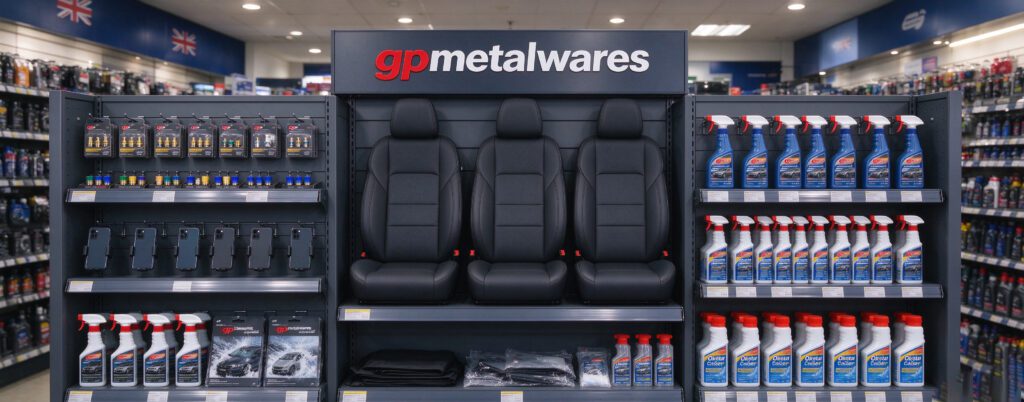
A car accessory floor display sits exactly where that lever works. It converts a customer who came in for a wiper blade into someone who also picks up a phone mount or a boot organiser. Gpmetalwares designs these units specifically for that add-on behaviour, rather than treating them as generic shelving.
Designing for UK Shop Floors and Right-Hand Drive Stock
British retail units are rarely generous with floor space. A typical bay might give you 900mm of width before you start blocking a walkway. Our standard footprint sits around 900 × 400 × 2500mm, which keeps sightlines clear while still offering four to five usable tiers.
Right-hand drive compatibility matters too. Mounting brackets for dashcams, phone holders and mirror accessories should be pre-configured for RHD layouts. Otherwise staff end up re-arranging stock, and the display stops looking intentional.
Material Options Beyond the Usual
We do not default to a single sheet spec. Depending on load requirements, clients can choose mild steel tube frames, thicker plate for base panels, or lighter gauge for upper tiers where weight is a concern.
For finishing, we use powder-coated metal as the standard. It gives a consistent, hard-wearing surface that resists the oils, greases and moisture common in a parts shop. RAL colour matching is available, so the unit can carry your own brand palette rather than a generic black.
Factory Facts Worth Checking Before You Order
Ask any supplier for three things: coating thickness reports, salt spray data, and a clear warranty start point. Reputable vendors state a coating warranty period, usually 12–24 months, along with the start node and the failure criteria used.
On the production side, watch for hidden costs. Some suppliers bundle pre-treatment, fixture wear and re-spray work into an attractive headline price, so request a full cost breakdown before signing. Long or strip-shaped components also need dedicated hanging fixtures, otherwise you risk missed coverage on the reverse side.
A Typical Retail Project Reference
A mid-size independent in the Midlands commissioned a run of double-sided floor units for interior accessories. The brief was simple: fit between two existing gondolas, survive weekly restocking, and allow quick format changes for seasonal promotions.
We supplied modular hook and bin configurations, with a reinforced triangular base for free-standing stability. Hook and bin positions can be repositioned without tools, which lets the retailer update the display as inventory changes. Post-installation, staff reported noticeably fewer re-shelving delays.
Measuring the Actual Sales Impact
Do not rely on anecdote. Set a baseline for the target SKUs over four to six weeks, then compare after installation. Track units per transaction and average basket value separately, since a display can lift one without moving the other.
Also monitor damage and returns. A poorly braced unit generates complaints that quietly erase any margin gain. Quarterly bolt and connection checks are a sensible safeguard.
Making the Next Step
If you are planning a refresh, start with a floor plan and your top twenty accessory SKUs. That gives us enough to propose a realistic tier layout and load rating. You can reach the team at Gpmetalwares to discuss custom dimensions, coating colours and phased delivery options.