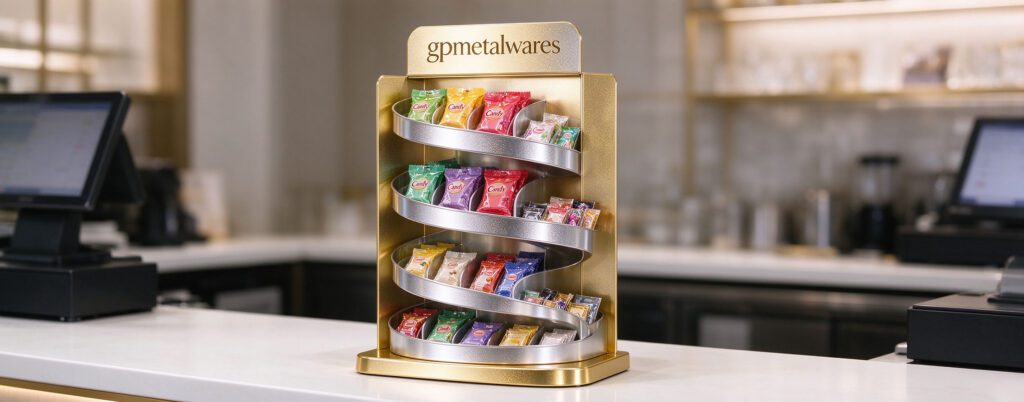
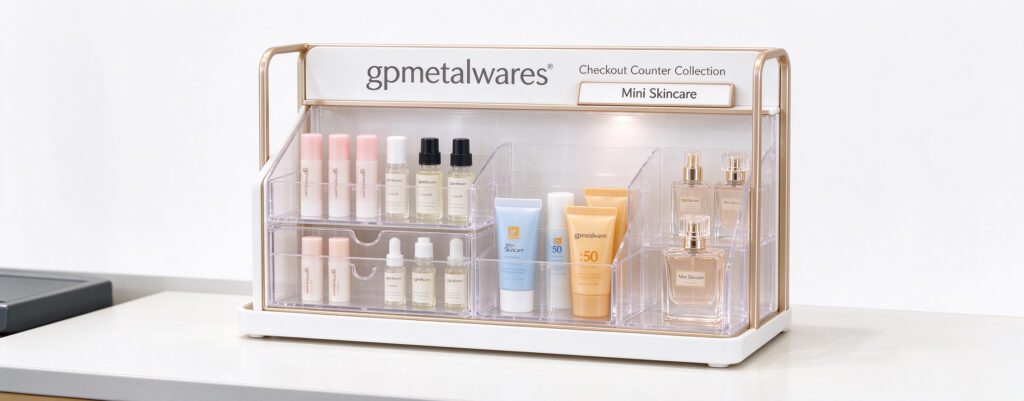
The travel-size cosmetic market hit $6.8 billion in 2025 and keeps climbing, and convenience retailers in Taiwan and across Asia want a piece of that, but the shelf space is tiny, and a cluttered counter kills the impulse buy, which is where a purpose-built travel size cosmetic small counter display comes in, as it grabs attention without wasting precious counter space, though done wrong it’s just another dust collector, so this guide covers what buyers and brand teams need to know before sourcing.
Why the Counter Matters More Than the Shelf
Convenience shoppers move fast. They want in and out. The counter is the last stop before the register. It’s also the highest-traffic real estate in the store. A well-designed travel size cosmetic small counter display captures attention during that final pause. According to category research, 68% of HBC shoppers will leave if their brand isn’t visible . A display that hides products fails. A display that presents them clearly at eye level succeeds. The counter isn’t storage. It’s a sales trigger.
What “Small” Actually Means in Store Fixtures
“Small” is relative. In convenience retail, it means footprint-conscious. Typical counter displays range from 10 to 20 inches wide and 1 to 3 feet tall . Depth matters too. A unit deeper than 8 inches eats into clerk workspace. The best designs use tiered or stepped trays. This lifts rear products into view without blocking the front. Adjustable dividers keep SKUs upright and organized. That way, a 50ml micellar water bottle doesn’t fall into a heap of lip balms. Modular components let retailers reset the layout as product lines change .
Material Choice: Where the ROI Math Gets Real
Most buyers default to cardboard. It’s cheap upfront. A corrugated counter unit might cost a few dollars per piece . But cardboard fails fast. Humidity warps it. Sunlight fades it. Product weight sags the shelves. Retail programs running longer than 8 to 12 weeks see cardboard degrade . Acrylic changes that equation. A cast acrylic display transmits roughly 92% of visible light, making products look premium . It resists moisture and holds shape for years. The crossover point sits around nine to ten months. Past that, acrylic wins on cost-per-use . For convenience chains running year-round HBC sections, acrylic is the smarter durable investment.
| Material | Upfront Cost | Lifespan | Best For |
|---|---|---|---|
| Corrugated Cardboard | Low (single digits per unit) | 8-12 weeks | Short promo bursts |
| PVC | Mid-range | 6-12 months | Temporary booth setups |
| Acrylic (PMMA) | Higher (tens per unit) | 2-5 years | Permanent counter programs |
| Mixed (Acrylic body + wood header) | Mid-high | 2+ years | Branded fixture with swappable graphics |
Data synthesized from industry material analyses .
Factory Facts: What Happens Behind the Build
Most acrylic counter displays come from Dongguan, China. The region hosts hundreds of fabrication shops. A typical factory runs 10 to 50 workers . Production lead times sit at 10 to 20 days for mass orders . Sampling takes 3 to 5 days. Sample shipping via express runs about a week. Minimum order quantities usually start at 100 pieces. However, that depends on color and size complexity . Custom Pantone matching adds a one-time fee of roughly $200 to $300 per color . That buys color depth printed board cannot match.
Custom Material Options Buyers Should Know
Acrylic isn’t one thing. Cast acrylic differs from extruded. Cast offers better optical clarity and machining stability. Colored acrylic comes in transparent, frosted, and opaque finishes. UV printing handles logos and product imagery. Laser cutting shapes the profile. Edge polishing removes sharp corners. For a travel size cosmetic small counter display, a common build uses 3mm to 5mm cast acrylic for the body and 2mm for dividers. Metal bases add ballast for stability. Wood-look headers deliver a craft aesthetic without the freight weight of solid wood .
Real Retail Project Reference: Lessons from the Field
Project: Multi-store HBC counter reset for a regional convenience chain (Southeast US, 2024-2025).
The retailer operated 120 stores. Travel-size HBC was scattered across pegboards and wire baskets. Sell-through lagged behind category averages. The brand team sourced a custom acrylic counter display with adjustable dividers and a swappable header panel. Rollout happened in three waves. Wave one covered 20 high-traffic stores. Results after 90 days showed a 22% lift in travel-size HBC units per store. The swappable header allowed monthly promotional updates without replacing the fixture. Total project cost per store landed under $85 when amortized over 24 months. That figure included freight and initial setup. The key win was fixture consistency. Every store presented the same brand block. Shoppers recognized it instantly.
Design Details That Drive Sell-Through
Tiered trays beat flat shelves. Stepped-row configurations lift rear products. This offsets height differences and keeps all SKUs visible . Dividers prevent chaos. Adjustable dividers accommodate different bottle diameters. Without them, products migrate and mix. Header space sells the category. A clear acrylic header holds printed inserts or brand messaging. Magnetic or slot-in mounts make swaps easy . Lighting is optional but potent. Small LED strips inside the display add perceived value. They also draw the eye in dimly lit c-store environments.
The Shipping and Assembly Question
Acrylic arrives assembled. That’s a feature, not a bug. Cardboard ships flat and requires store staff to fold and build. Assembly quality varies by whoever is on shift. Acrylic ships in engineered cartons. Unbox, position, load product. Setup time drops to minutes. Freight costs more because acrylic is heavier and bulkier. That’s a one-time hit per fixture. Cardboard pays freight every campaign cycle . For chains running multiple promotions per year, the freight math favors durability.
Sustainability Is No Longer Optional
Retailers ask about end-of-life. Cardboard recycles at roughly 96% in the US . Acrylic recycling streams remain less developed. However, a durable fixture serving two to five years generates zero campaign-cycle waste. That beats replacing board four times a year. The hybrid approach works best. Use a permanent acrylic base and tray. Swap only the printed graphic panel each campaign. The fixture budget buys durability once. The campaign budget buys only what changes .
Sourcing Checklist for Brand and Retail Buyers
Before you request quotes, gather these specs. Dimensions: Width, depth, height. Confirm counter depth at target stores. Tier configuration: How many levels? What product heights? Divider count and adjustability: Fixed or movable? Material grade: Cast acrylic vs. extruded. Color and finish: Clear, frosted, colored, UV-printed. Header type: Printed insert, magnetic, or permanent print. MOQ: Typically 100 units for custom acrylic. Sample lead time: 3 to 5 days standard. Production lead time: 10 to 20 days for mass orders. Packaging: Engineered cartons for damage prevention. Ask for the factory’s damage rate. Top shops run low single-digit percentages.
The Bottom Line
A travel size cosmetic small counter display is not a commodity. It’s a sales system. Cardboard works for a flash promotion. Acrylic works for a program. The fixture you choose signals how serious you are about the HBC category. Convenience shoppers decide in seconds. Give them a display that makes the decision easy.